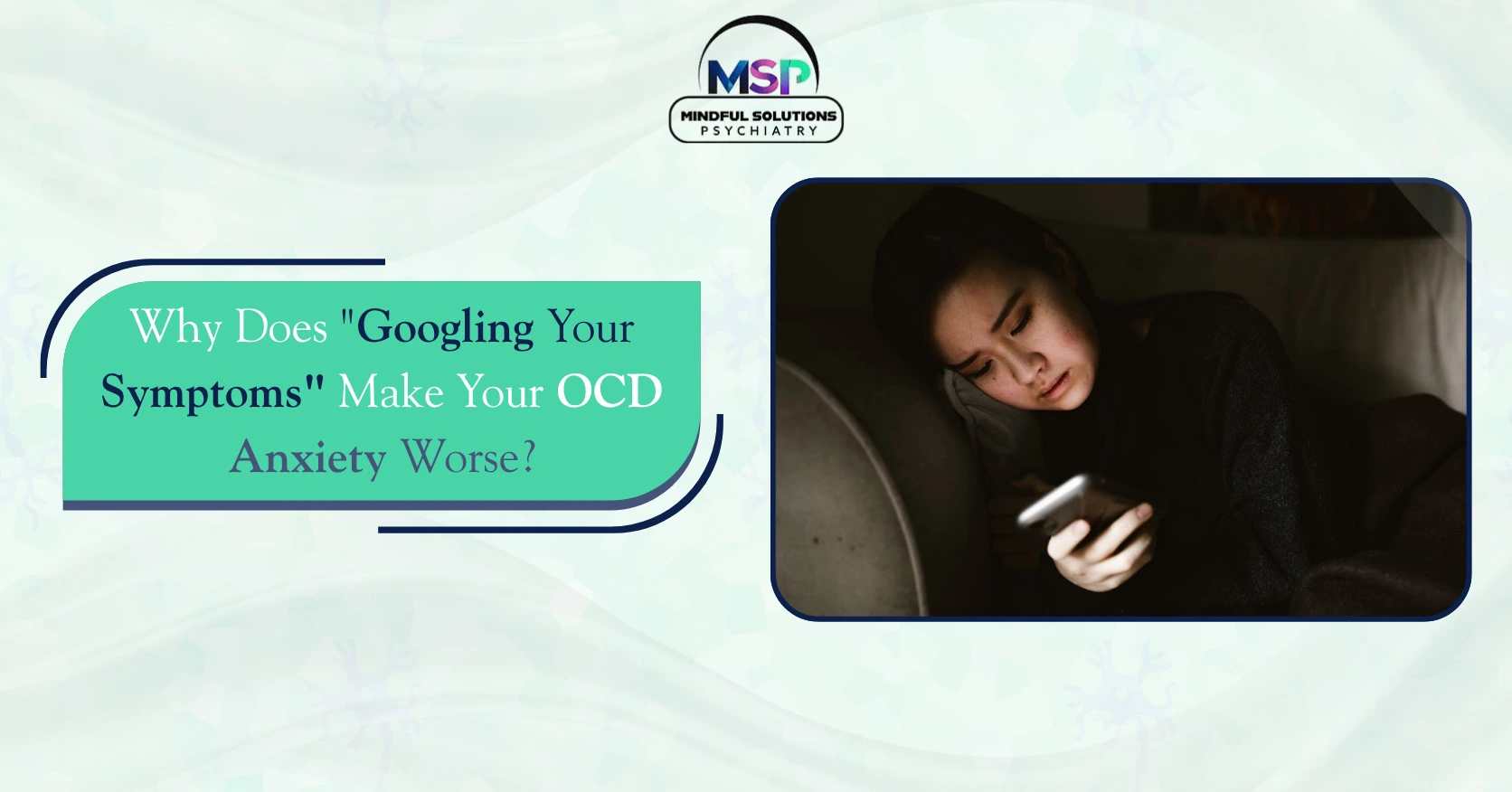
You feel a sudden chest pain, so you grab your phone and frantically Google it. Ten minutes vanish. Suddenly, you find yourself diagnosing exceptionally rare diseases, while your heart pounds wildly. This occurs repeatedly because you sought a quick answer for reassurance, only to encounter sheer terror. Whenever you suffer from Obsessive-Compulsive Disorder or basic health anxiety, browsers are vicious enemies. Hunting for symptoms provides a temporary splash of relief. It evaporates quickly. Then the heavy worry rushes back, hitting you stronger than before. Let us explore the true reason your panicked online searches consistently make that deep anxiety feel so drastically worse.
What Is Cyberchondria?
Cyberchondria is a broad term for a common issue, referring to the anxiety that arises from consuming health-related content online. If you have OCD, this is a fatal trap. Your brain distrusts everything. You start suspecting the doctor ignored something vital. (That exact thought happens all the time). So, you start searching again. You scroll through medical forums looking for clear proof that you’ll survive, but the Internet mostly highlights worst-case stories. Discovering actual safety online is a complete illusion.
The Reassurance Trap: How Searching Feeds OCD
Googling your symptoms is a compulsion, an action designed to halt your anxiety. It rarely works. This grinding cycle murders your peace and always looks exactly like this:
- The Trigger: You register a basic body quirk, or a ghastly thought hijacks your focus.
- The Search: You jump online to diagnose the terrible disease killing you.
- The Brief Relief: You find a calming post and feel totally safe for two minutes.
- The Bigger Doubt: Your brain launches another “what if” attack, so you start clicking links again.
Searching does not plug the gaping leak in your bucket. It simply heaves more water into a vessel riddled with holes. Each time you check a symptom, you are teaching your brain a very toxic lesson. You learn that obsessive checking is the only method to survive. Break the habit. Close the browser window right now.
Why Do Physical Symptoms Feel So Real?
Your symptoms are actually real and you are not making them up in your head. When you get scared, your body turns on its fight or flight response. The National Institutes of Health (NIH) states that strong stress can cause a fast heartbeat, tight muscles and a sick stomach. (You can read more about stress on the NIH.gov website). Your brain thinks you are in danger, so it sends out loud alarm signals. Anxiety creates the exact physical signs you fear the most. According to the Centers for Disease Control and Prevention (CDC), long term stress affects your whole body by causing headaches and severe sleep problems. (Find more details at CDC.gov). When you spend hours Googling, you keep your body in a high stress state, which creates even more physical symptoms for you to worry about.
Search Engines Versus Forums and AI Chatbots
People look for comfort in different places online and each place feeds OCD in a very different way.
- Search Engines: You look for simple facts, but search engines show you rare and scary diseases first, so you keep clicking until you find something terrifying.
- Online Forums: You read posts from strangers because you hope someone else had your exact symptom. But comparing yourself to strangers just creates new doubts, especially when their story is slightly different from yours.
- AI Chatbots: You ask an artificial intelligence chatbot the same question ten ways because a computer will always answer you. It does not get tired and it never tells you to stop asking.
All of these tools give you a fast answer, but they never give you lasting peace.
The Problem with Waiting Just Fifteen Minutes
You might read about the fifteen minute rule online. This rule tells you to wait fifteen minutes before you search your symptoms.
Is this actually helpful?
Sometimes, it is just another trap. If you just stare at the clock, you are still engaging in a compulsion. You are just delaying it, as true healing means letting the urge pass completely and you must engage in your real life. Do the dishes, walk the dog and call a friend.
Let the anxiety sit in the back seat. Do not let it drive the car.
Is It Research or an OCD Compulsion?
Sometimes, you really just need a doctor, but how do you know if you are doing normal research or doing an OCD compulsion? Look at the main goal of your search. Here is how you can tell the clear difference:
- Normal Research: You want a fact, find the answer, close the tab and move on with your day.
- OCD Compulsion: You want a feeling, hoping to feel completely safe. But that feeling never lasts, so you keep searching even after you find an answer.
Research ends with a simple fact, while a compulsion ends with a feeling. And feelings always change.
Why a Doctor Cannot Always Fix the Fear
You finally go to the clinic where the doctor runs tests and the results are perfect. You are healthy.
For most people, this is great news, but for an OCD brain, it is not enough.
OCD demands total certainty and wants complete proof, but medicine cannot give you that. So, you go home and start Googling again because you think the test might be wrong. This is why standard medical comfort fails for health anxiety, since the problem is not your body. The problem is the doubt.
Sometimes, family members try to help by telling you that you are fine. But asking your family is just another form of checking, acting just like an offline search engine.
Breaking the Loop with Expert Care
You have to stop feeding the doubt.
You cannot beat OCD by reading more articles; you beat it by learning to sit with the worry. This is very hard to do alone, but evidence based treatments work very well.
Mental health professionals use specific tools to help you stop the checking habit.
- Cognitive Behavioral Therapy (CBT): This therapy helps you challenge scary thoughts and teaches you how to stop assuming the worst.
- Exposure and Response Prevention (ERP): This is the best tool for OCD because you learn to feel the anxiety without doing your compulsion. You stop the Google search and over time, your brain learns that the anxiety goes away on its own.
- Medication Management: Sometimes, therapy needs a boost, so the Food and Drug Administration (FDA) approves certain medications to help calm the intense worry. (Information is available at FDA.gov). Medicine can make it easier to practice your therapy tools.
How Mindful Solutions Psychiatry Can Help You
Healing is possible and you do not have to live in constant fear of your own body.
At Mindful Solutions Psychiatry, we provide expert care for OCD, anxiety and depression for patients ages 10 and up. Our team takes the time to listen to your unique story without judgment.
We offer personalized treatment plans that fit your exact needs.
Our services include:
- Comprehensive psychiatric evaluations.
- Medication management for anxiety and OCD.
- Supportive care focused on long term emotional balance.
- Flexible telehealth appointments and in person visits.
We serve patients in Garland, Texas and Washington state because you deserve to feel heard, valued and empowered. Our experienced mental health professionals are ready to help you regain control of your life.
Put down your phone, close the search tabs and let us help you find real peace of mind. Reach out to Mindful Solutions Psychiatry today to book your appointment.
FAQs
Q. How is a normal search different from an OCD trap?
Normal searches look for a clear fact. An OCD trap looks for a safe feeling. Facts stay the same, but feelings always change.
Q. What is cyberchondria?
It is the fear you feel after reading health facts online. It makes the brain doubt everything and expect the worst.