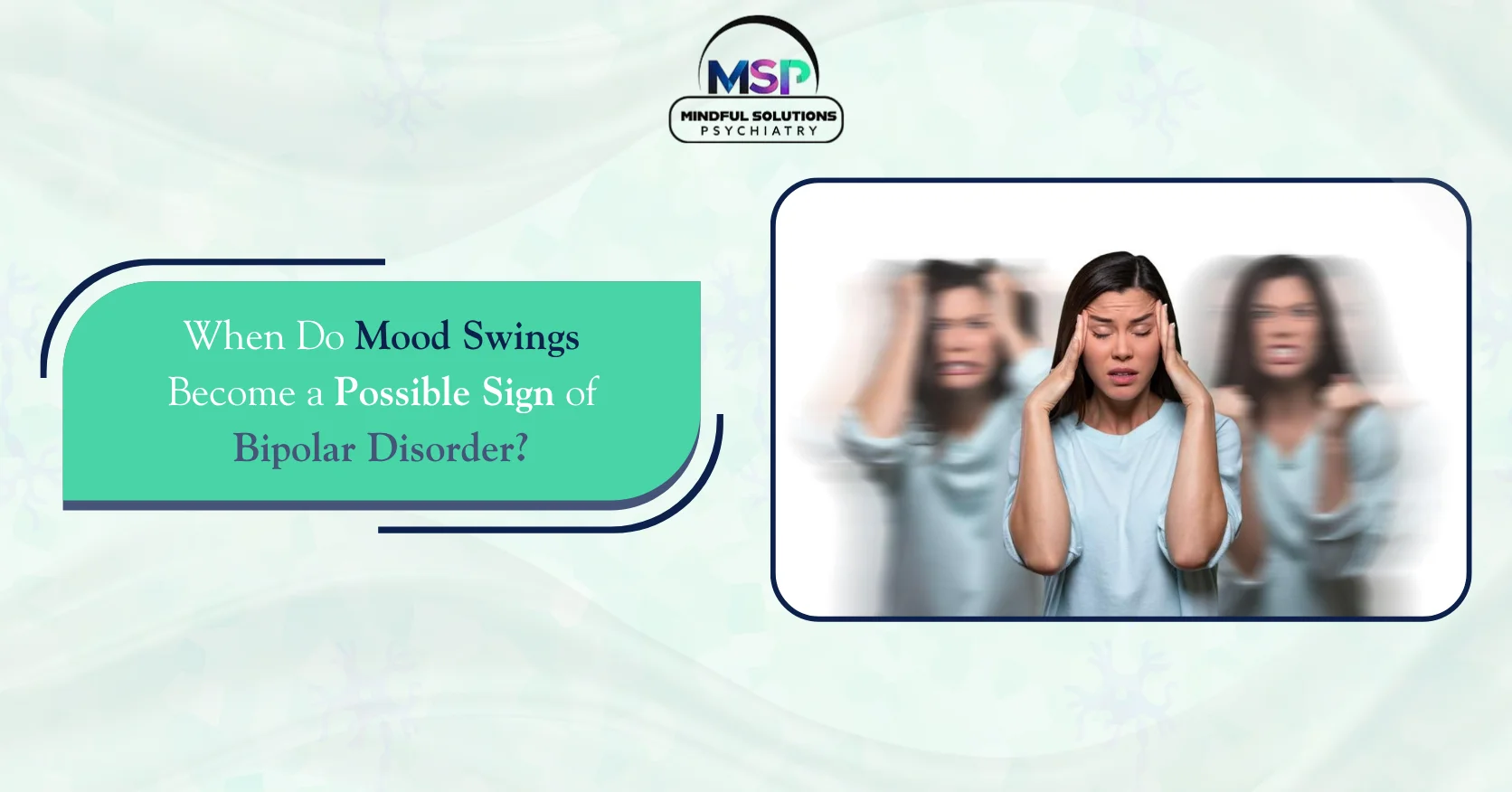
Do your emotions feel like a roller coaster? One minute you’re great, the next you’re down. Everyone experiences ups and downs. Joy comes from good moments, like winning, while sadness or anger arises from conflicts. It’s all part of growing up.
But what happens when these feelings are too big? What if they last for a long time and make it hard to live your life? If the feelings are extremely strong and lasting, it may not be a typical mood change. It could be a possible sign of bipolar disorder.
At Mindful Solutions Psychiatry, we pay attention to mood changes. A proper evaluation can find out what is going on and lead to the right treatment.
So, when mood swings become a possible sign of bipolar disorder. Let’s look at this.
Understanding Everyday Mood Swings
Mood swings occur regularly and they do so for a clear and specific reason. You are excited when you receive a fun, new toy. When you fall and injure your knee, you get upset. Your emotional state is aligned with your external circumstances.
Having regular mood swings doesn’t keep you from living your life. You can still go to school. You can still play with your friends. You can still clean your room and eat dinner.
Even when you are sad or grumpy, the bad feeling goes away soon. You start feeling like yourself again in a short time.
What Makes Bipolar Mood Swings Different?
Sometimes, mood swings are much bigger and stronger. They don’t wear off after a couple of hours. Rather, they can last for days, weeks, and even months. If feelings change very intensely, it may be an indication of a mental health condition called bipolar disorder.
Bipolar disorder is a real brain illness that affects about 1-4% of people worldwide. It causes someone to alternate between two intense emotions. One feeling is an extreme high. The other feeling is a deep low.
These changes are not just bad and happy days. They affect the way a person thinks, acts, sleeps and feels each day.
The Highs: Recognizing Mania and Hypomania
The high times in bipolar disorder are called mania or hypomania. Hypomania is a smaller high, while mania is a bigger high. When a person is in a high period, their energy level is excessive. Their body goes all day and all night without feeling any fatigue.
Here are common signs of a high period:
- Feeling super happy, excited, or very angry for days in a row
- Needing only two or three hours of sleep without feeling tired
- Talking so fast that other people cannot understand the words
- Thinking way too many thoughts at the same time
- Doing unsafe or unwise things without thinking about the rules
When you’re in a high period, you feel like you can do everything. You often fail to see the genuine threats around you.
The Lows: Recognizing Bipolar Depression
After a high period ends, a person with bipolar disorder often drops into a low period. This is called bipolar depression. This is much harder than just feeling sad for an afternoon.
Here are common signs of a low period:
- Feeling very sad, lonely, or empty almost every day
- Feeling tired all the time, even after sleeping for many hours
- Not wanting to play, eat, or do things that used to bring joy
- Having a hard time paying attention at school or work
- Finding it very hard to get out of bed in the morning
During a low period, simple tasks like brushing teeth or eating breakfast can feel like climbing a huge mountain.
When Do Mood Swings Become a Possible Sign of Bipolar Disorder?
You might be asking how to tell the difference. You should pay attention to how much the mood swings change your life.
Duration
Normal feelings change in a few hours. Bipolar feelings stay high or low for many days or weeks.
Trigger
Normal feelings happen because of something real, like a bad test score. Bipolar feelings often happen with no clear reason.
Intensity
Regular swings match the problem. Bipolar shifts feel way too strong and take away your self-control.
Impact
Normal feelings go away quickly. Bipolar shifts make it hard to live a normal, happy life without extra help.
Consider asking these questions:
- Do these mood changes stop you from going to work or school?
- Do they cause big fights or problems with your family and friends?
- Do they make you do dangerous things?
- Do they last for a long time, like many days or weeks?
If the answer to these questions is yes, it might be time to talk to a doctor. Big shifts that hurt your daily life are a clear sign that you need extra support.
Tracking Your Moods
If you are worried about your feelings, try keeping a mood diary. A mood diary is a simple notebook where you write down how you feel each day. You can record if you felt happy, sad, or angry. You can also write down how much you slept.
Doing this every day helps you see a pattern. You might notice that you feel very high for one week, and then very low the next week. Bring this notebook to your doctor to help them understand your feelings.
When It Is Time to Seek Professional Help
If mood changes stop you from having a good day, it is time to ask for help. You do not have to fix big feelings all by yourself. Talking to a caring doctor or counselor is the best choice.
A mental health provider can check your symptoms. They can tell you if your feelings are normal or if you need extra support for bipolar disorder. Getting help early makes a huge difference.
How Mindful Solutions Psychiatry Can Help
You do not have to deal with big mood shifts on your own
At Mindful Solutions Psychiatry, we provide mental health care based on each person’s needs.
We provide expert psychiatric care for patients ages ten and up. This includes kids, teens and adults.
Our team offers full psychiatric evaluations to see what you need. We can also help create a treatment plan when bipolar disorder or another condition is found. We provide medication management and other forms of mental health support.
We offer both in-person visits and safe online video visits. You can get the support you need to feel like yourself again.
Take Mood Changes Seriously
Mood swings are common. They do not always mean bipolar disorder.
But very strong mood changes should not be ignored.
If mood changes come with very high energy, little sleep, risky behavior, or deep depression, it may be time to talk with a mental health professional.
With proper care, people with bipolar disorder can work toward better mood control and a healthier daily life.
Reach out to us at Mindful Solutions Psychiatry. We are here to help you every step of the way on your journey to feeling better.
FAQs
Can a child have bipolar disorder?
Yes, young children can have it. But it is much more common for doctors to find it in older teenagers and grown adults. A doctor needs to look very closely to be totally sure.
Is bipolar disorder my fault?
No, it is never your fault. It is a health problem in the body, just like a bad cough or a broken arm. It just needs gentle care from a good doctor.